

Bungie’s Marathon is winding down its first season before things escalate in Season 2. There are some big changes coming to the game, including new weapons, playable characters (called Shells,) a spin on a familiar map and other promised shake-ups to bring back that “launch week magic.” As someone who is rather casual when it comes to the shooter genre, especially in the competitive online environment, it has been strange to find myself logging in every single night to play Marathon and even more jarring that my Playstation 5 dashboard claims I’ve poured over 400 hours into the game. I’ll confess that the game has swallowed my life and free time to the point of near detriment. It’s also the best time I’ve had in a multiplayer shooter in over a decade.
Digital Ephemera
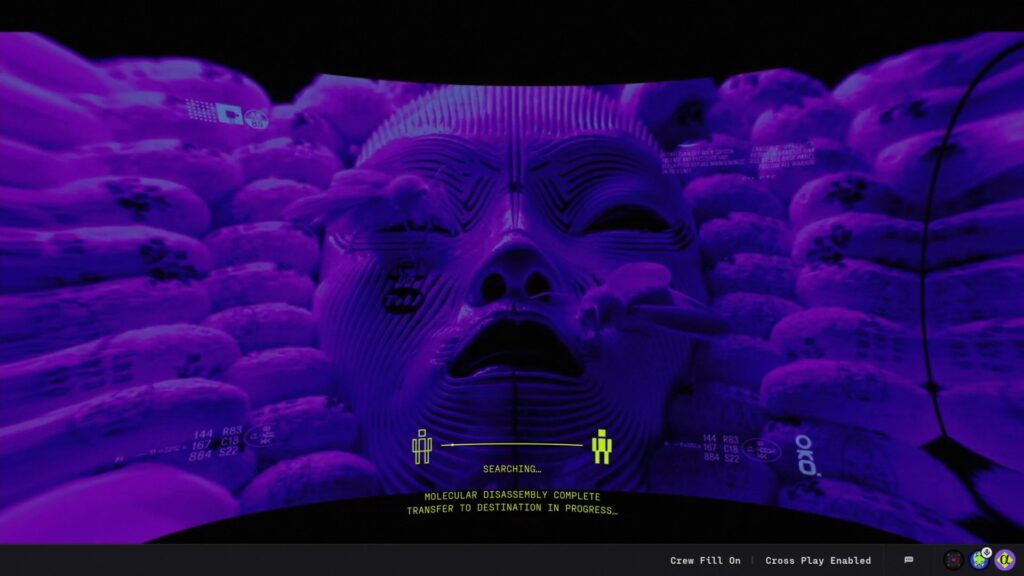
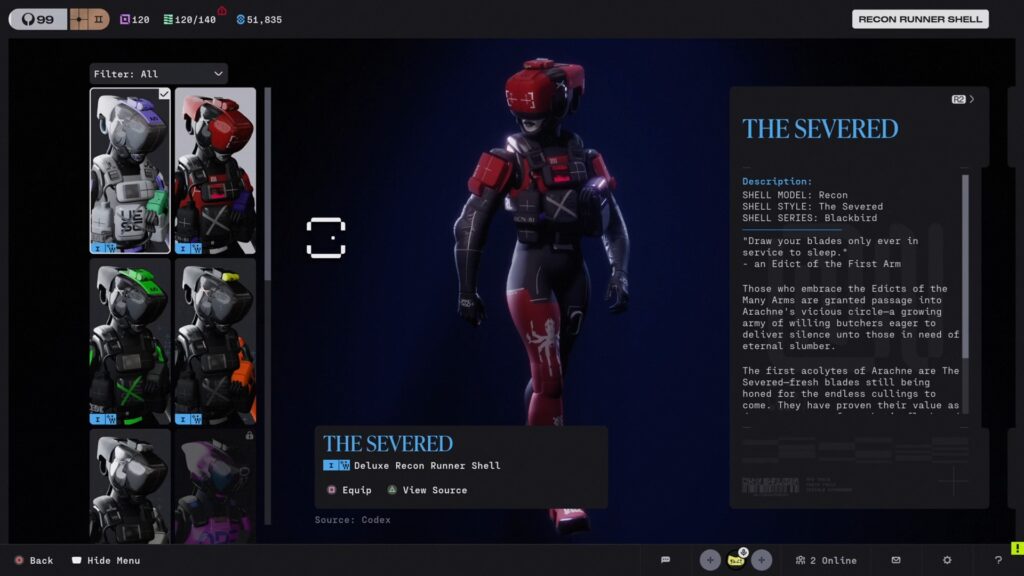
Marathon is a very interesting beast in the extraction shooter genre. Aesthetically it is unlike anything other game like it and while its vibrant yet eerie 3-D printing-inspired “graphic realism” may not be for everyone, it is undeniably immersive the second you lay eyes on it. As a consciousness stored remotely in a server farm incalculable miles away from the actual battlefield, your disposable Runner Shell bodies ease you into their personalities through gameplay. Even as someone who primarily runs solo, the Runner Shells have a commanding presence in both their speech and appearance that makes you understand their attitudes when listening to them, fighting alongside them or facing off against them. Each Shell also has a few abilities, much like those found in popular hero shooters, that also add to the personality of each one. Your Shell selection is also the first step you take into Marathon’s enduring cyberpunk dystopian fantasy.
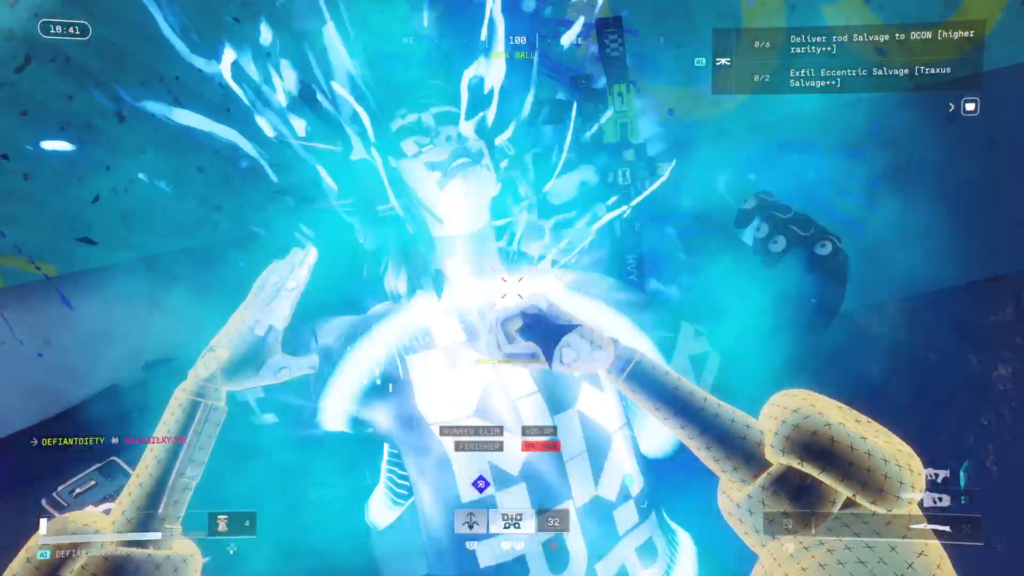
While other extraction shooters such as Arc Raiders or Escape from Tarkov leverage a more grounded appearance that offers an undeniable tension when encountering another player decked out in practical combat gear, the strange biotech beings of Marathon and their robotic UESC counterparts inspire a unique sense of dread when they notice you. This feeling comes full-circle after you’ve been on the receiving end of one of the surprisingly graphic finishers that you can perform on a downed Runner, as the only sound you or your assailant hears is the unnerving “thunk” of the knife going into the synthetic skin of another player to end their run. That synthesis of the intuitive feeling of a traditional FPS knife execution mixed with a noise and surreal sparks of light that follow, giving the facade of a machine shutting down, is the perfect way to end a tense gunfight where the only thing lost is a disposable and mass-produced body.
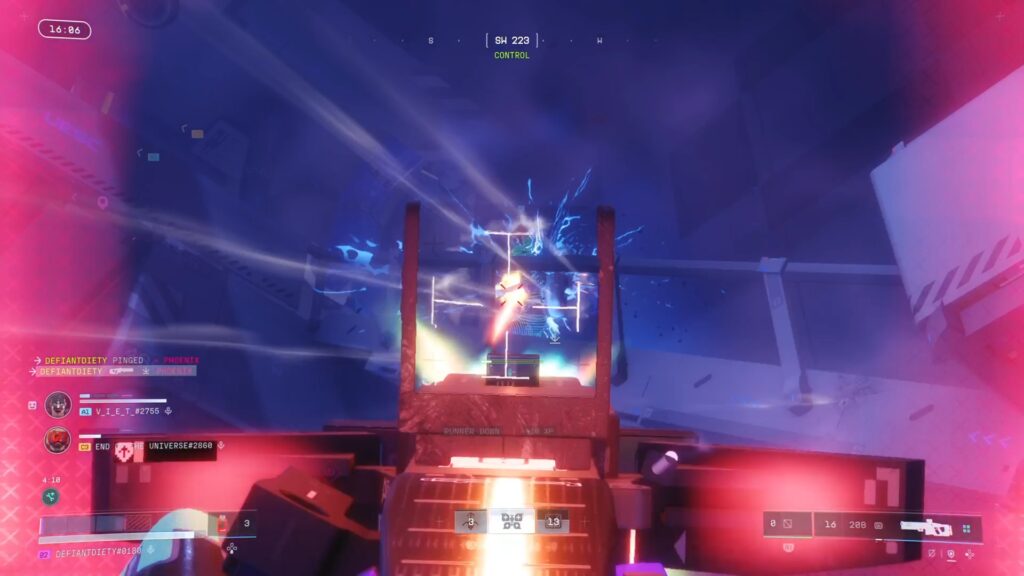
The aesthetic extends into the greater game feel in a natural way since your equipment fits the same type of disposable 3-D printed aesthetic. Guns and explosives in Marathon feel and sound just as otherworldly as the planet you’re on. Jittering clicks of homing shrapnel follow targets of Flachette Grenades, the BRRT SMG sounds and feels like a laser rather than a traditional projectile weapon which makes the suite of projectile-based, battery-powered energy weapons feel fresh and unique. That’s to say nothing of the incredibly rare “prestige” level gun attachments that transform a once-familiar feeling gun into an over-charged killing machine which adds even more to the Lego-esque identity of these cheaply-made instruments of death.
All of this blends together beautifully in every battlefield. Whether it be the lush, colorful landscapes of maps such as Perimeter or Dire Marsh, or the cold and unforgiving innards of the UESC Marathon ship itself via the Cryo Archive. While restrained in scope, the maps are very well thought-out with fantastic environmental design and encounters that almost always feel worth risking your run for. That target could be the mysterious sample on the enigmatic Anomaly in Dire Marsh or the UESC cargo convoy on Perimeter, but danger in the world is always balanced by these opportunities for immense profit. The battles that happen as a result of these pursuits are also equally as thrilling, win or lose.
While the police robots of the UESC will constantly pester you, it’s rival Runners who will always be your main competition to these opportunities. Indeed, wherever it is you may see opportunities for profit so do others see that same opportunity over your dead body and much of the pulse-pounding action comes from the moments where your paths cross. In Marathon, you’ll often find yourself employing whatever weapon you have when facing off against enemies and rival Runners in fast-paced gunfights where positioning and strategy take the front seat over pure aim skill, even if the head is still always the best place to shoot. When coupled with the exquisite sound design that allows you to feel where your enemies’ footsteps land around you, environments such as the Bio-Research Lab on the Dire Marsh become games of sensory cat-and-mouse with brutal endings that yield potentially juicy rewards. Each of these endings begets your next adventure’s beginning which is normally finding a way to extract with your hard-fought treasure, which could reset the cycle anew which leads to even more exciting gunfights and tales of valor won or lost.
Minds in the Machine
In spite of everything, you’re never alone on Tau Ceti IV. Even if you choose to do your runs solo you’ll have the mysterious ONI, your On-board Navigational Interface given to you by the in-universe corporation of CyberAcme, chirping updates to you via your neural connection. This connection broadens to other entities that represent parties interested in the various military and technological assets that have been abandoned on the planet for nearly one-hundred years. Many of these are corporate representatives enlisting you to retrieve specific assets or data from the long-abandoned colony in an effort to understand why the UESC’s governance on this expedition led to such a catastrophe.
That isn’t everything, however. You’ll engage in sabotage, self-harm, espionage and even neurological experimentation if you follow every priority contract given to you. If not immediately, you’ll increasingly feel the weight of indifference to you as an individual that serves to crush whatever semblance of humanity or “self” you may still be harboring. It’s shockingly effective. Through this cold, results-driven correspondence you are pushed to simply keep pursuing the goals placed in front of you, be they self-appointed or in relation to a contract, no matter how many shells you go through or Runners you kill. Everything is disposable and replaceable, including you.
While the main element that makes this feeling palpable may be the sense of loss when dying during a run and losing everything in your inventory, there are quite a few more subtle touches to reinforce this feeling of impermanence. Each weapon comes with four “traces” which deplete by one every time that weapon is looted off the body of a Runner. When a weapon has no more traces, it is automatically sold upon exfil. It’s an interesting mechanic and a nice way to balance the weapon economy, even if the addons to the guns do most of the heavy lifting in-game.
All of these small touches make experiencing Marathon incredibly immersive. It makes you care about the small lore snippets you find due to collecting valuable items such as unsent missives or literal evidence folders. The chilling audio logs that you’re rewarded with almost always contain information on what exactly went down on the colony of New Cascadia and how it became the hellscape you traverse now, with the various priority contracts weaving together a story of exactly what these mysterious corporate employers of yours want out of this. It all makes Marathon once again stand out amongst its extraction shooter peers in that its themes become crystal clear the longer you engage with its world and succeed in your runs.
Machine-Made Fantasy
Looking back on the season gone by, it’s still hard for me to believe I’ve put so much time into the game. I was not a Destiny fan and was never able to stick with it, no matter how much I tried. There was never a time that the Battle Royale bug bit me and while I have some hero shooters that may rival Marathon’s play time, those are games that are either in maintenance mode or hardly resemble a time when I was actively playing the game. There is something about the world of Tau Ceti IV that makes you want to keep going that persists beyond the potential to find valuable loot or devastating weaponry that you only feel after you’ve allowed the game to immerse you in it. After that, a failed run rarely feels like true defeat.
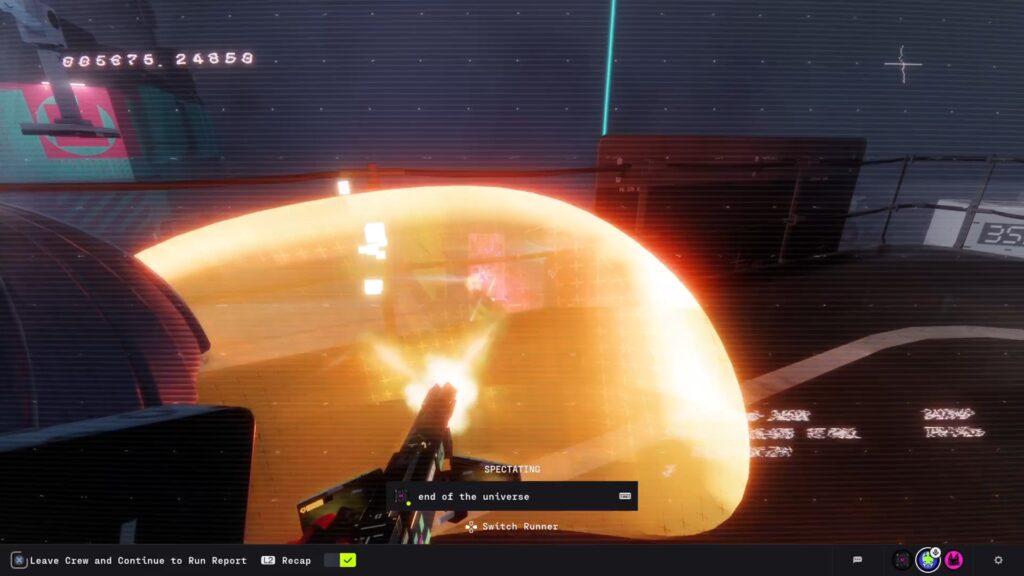
The fun is found each time you discover something new. Whether it be a weapon, weapon attachment, game-changing cores or implants, an interesting valuable, the lore entry it unlocks within the in-game Codex, the progression towards a unique and unlockable skin that may bring; all of it feeds into itself under the cold and results-driven narrative of pragmatic corporatism. The unique aesthetic direction serves as both a fresh take on a shooter environment and as reinforcement of its cold and calculating philosophy by utilizing artificial, 3D printed environments
Marathon is special to me and undoubtedly many others. There’s a lot to love and the agility of Bungie is something rarely seen in the AAA developer space. If you’re playing Marathon with friends or simply jumping in for the casual run then you’re probably just enjoying your time with an excellent Extraction shooter. However the wider community may feel about the game, or whatever figures they may use to justify its existence (or cause for shutdown/death,) Marathon is a game that FPS fans should not ignore. It may not be for everyone, but it is undeniably for those looking for a best-in-class extraction shooter experience.
Be sure you’re ready for Marathon Season 2 by checking out our 5 Essential Tips!